

If you live in DC or are visiting, at some point you might get to enjoy a performance at the Kennedy Center for the Performing Arts. Your focus will probably mostly be on the production you’ve gone to see. But while you are there, the building itself will no doubt capture your attention as well.
The Kennedy Center for the Performing Arts was designed by architect Edward Durell Stone. Let’s take a closer look at its history and design, as well as the situation facing the building today.
A Project Long in the Making

The origins of the Kennedy Center can be traced back to Eleanor Roosevelt, who raised the possibility of a national cultural center in 1933. During the Great Depression, a lot of performers were struggling to find work, and a national center might have helped.
The idea wouldn’t gain momentum until 1950, however, when US Representative Arthur George Klein proposed a bill for a national cultural center. It passed in 1958. One year later, Edward Durell Stone became the project’s architect.
Original cost estimates for the structure had been around $30 million. By the time Stone presented his plan, his estimates had reached over double that. Fundraising began during President Dwight D. Eisenhower’s term, but got a lot further under the leadership of President John F. Kennedy. After Kennedy was assassinated, the project became dedicated to him to serve as a “living memorial.”
The building was named the John F. Kennedy Center for the Performing Arts by Congress in 1964, which was also the year groundbreaking took place. Construction costs ultimately reached $70 million, much of which was financed through gifts and donations. The Kennedy Center opened in 1971.
An Iconic Example of New Formalism

The Kenney Center is one of the best-known examples of a modernist style of architecture known as New Formalism. In fact, it typifies many elements of that style in its box shape, monumental scale, raised dais, symmetrical design, and slender columns. In fact, you can see a similar shape and style in some of Stone’s other works, especially the 1959 US Embassy in New Delhi.
The Kennedy Center’s dimensions are 100 ft. high x 630 ft. long x 300 ft. wide. 3,700 tons of carrara marble were donated by the government of Italy for its construction. The photo above really captures how vast The Kennedy Center is. It may not seem to at first, but you are not seeing the entire façade. What you are seeing is just the walkway that goes around the top of the building!
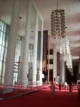
The interior of the Kennedy Center feels quite monumental as well, thanks to its 250 ft. long corridors, the Hall of States and the Hall of Nations. The Orrefors crystal chandeliers hanging from the 63 ft. high ceilings were donated by the government of Sweden. The inside also features some famous artworks, including the Bust of John F. Kennedy by Robert Berks.
The Current Situation
The Kennedy Center has been well-cared for over the decades. $200 million worth of improvements and repairs were made to the building between 1995 and 2005. A significant expansion called REACH opened in 2019.
At the time of this writing, however, the Kennedy Center is in jeopardy. The situation began in 2025, when Donald J. Trump terminated existing board members, appointed an interim executive director and new board members, and was then subsequently elected by them as the new chairman.
On December 18th, 2025, the board voted to rename the center as “the Donald J. Trump and The John F. Kennedy Memorial Center for the Performing Arts, or the Trump-Kennedy Center.” As the board did not cite a legal authority to make this change, the building is still named the John F. Kennedy Center for the Performing Arts under federal statue. In December, Trump’s name was added to the façade.
We will not get into the legal complexities of the situation. What is most pertinent is that in February 2026, Trump announced the Kennedy Center would close for two years of renovations. Considering he had the White House East Wing demolished, there is concern about the Kennedy Center’s fate.
In May 2026, Judge Cooper of the US District Court for the District of Columbia ordered the Kennedy Center to return to its original name inside of 14 days, and for the renovation to be reconsidered (the same judge blocked the center from adding Trump’s name again in September 2026).
Trump has said if his demands go unmet, the Kennedy Center could be “ripped down.” A photo that was taken aboard Air Force One on September 16th shows Trump and Bill Pulte looking at a poster board with the title “Kennedy Center DEMOLISHED” on it.
As of the time of this writing, the Kennedy Center still stands. This is the time for members of the public who care about the Kennedy Center as a building or as an institution to voice their opposition to its demolishment or harmful renovations. The Kennedy Center is beloved by many across the political spectrum. Its historical and architectural significance make it an irreplaceable part of our American heritage, one that transcends partisan divisions.
If you enjoyed this post, you may also like The Robert C. Weaver Federal Building: Letting in the Light and The Weighty Lightness of Dulles International.
And of course, don’t forget to follow us on Instagram, Facebook, Pinterest and YouTube for more Atomic Ranch articles, house tours, and ideas!