

Have you ever noticed that there are quite a few savings & loan buildings that feature Mid Century Modern architecture? MCM became a prominent style for these and other commercial financial buildings due to a combination of cultural and economic factors, especially during the post-war economic boom. Let’s take a look at why so many financial institutions chose this style, as well as a few examples of MCM savings & loan buildings.
Mid Century Modern Savings & Loan Architecture: Why It Took Over
During the early 20th century, most financial buildings featured classical architectural styles. Starting as early as the 1930s, however, some financial institutions began looking toward styles such as art deco and MCM.
Part of the reason was practical. Classical banks featured closed-off, unfriendly designs with significant barricades. More modern styles opened up the design of financial buildings, making them more inviting and efficient.
But there was also a cultural shift both between wars and after WWII. Financial institutions had long symbolized tradition. But as the world began looking toward the future, financial institutions wanted to embody ideals like progress and modernity.
Savings & loan buildings especially invested in this trend, since they had a strong focus on mortgages. Following WWII, the economic boom led to the construction of large suburban housing tracts, many of which featured MCM home styles.
It made sense for commercial structures to reflect those same styles. A savings & loan building featuring the sleek lines, open spaces, and modern materials of MCM appealed to the same consumers who would take out mortgages to buy MCM homes.
Famous Examples of MCM Savings & Loan Buildings
Let’s check out examples of a few well-known savings & loan buildings with a Mid Century Modern style.

One of the most iconic MCM savings & loan buildings is the Coachella Valley Savings #2 building designed by E. Stewart Williams. The building was completed in 1961, and is located in Palm Springs. Williams is mostly famous for his Desert Modernism, but this building exemplifies the International Style. The most striking feature is the inverted arches on the front of the building.

Above is the American Federal Building, which was designed by Robert Murphy and completed in 1963. It used to be located in downtown Orlando. At the time, it was just two stories, but five more were added in 1973. Although the building was not saved from later demolishment, the Nils M. Schweizer Fellows and the local AIA chapter managed to salvage the concrete latticework. A segment of that latticework is now located at the Orange County Regional History Center, also in Orlando.
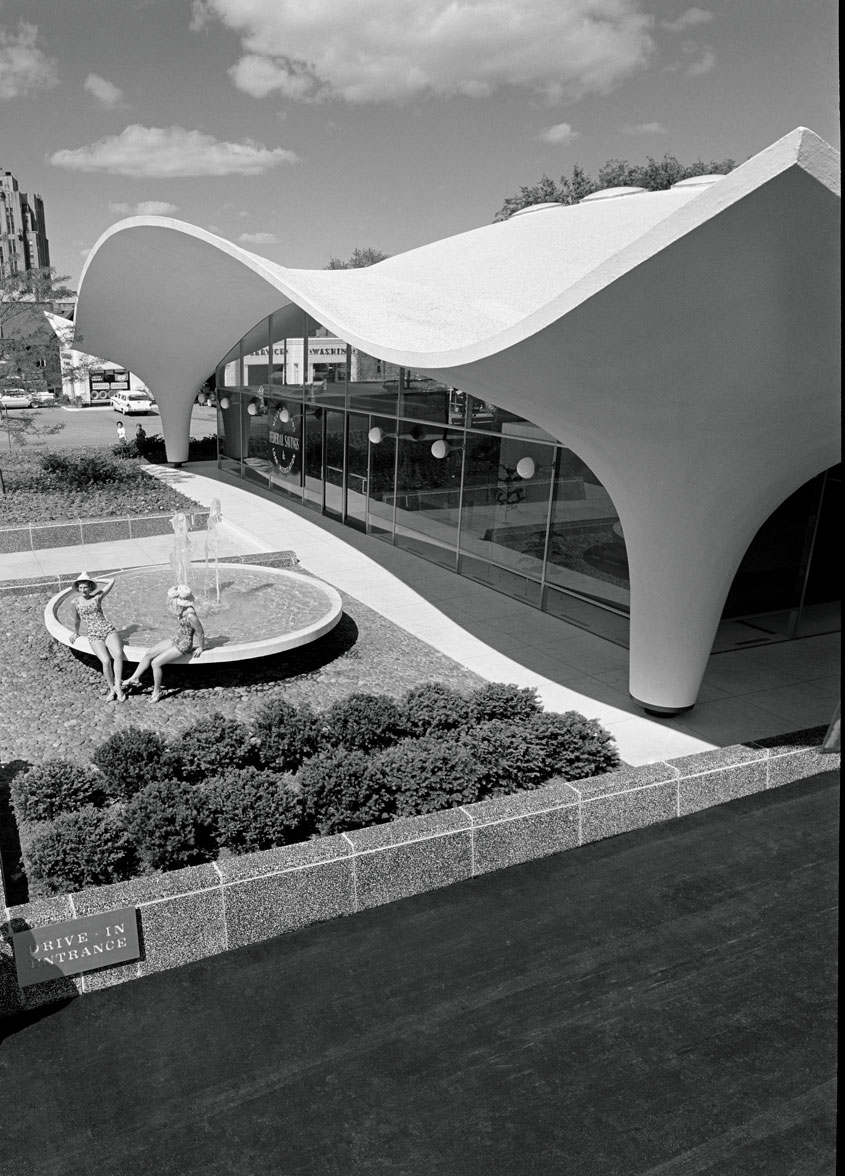
The Mount Clements Federal Savings and Loan Association building in Michigan was designed by William Kessler. Its concrete roof has a flowing shape with smooth, graceful curves. The top features 21 skylights, ensuring that the interior has plenty of natural light. A. D. Brewer, president of the institution, said, “The building will be as breathtakingly modern as the automobile, the airplane and the space missile. It will be the showplace of Mount Clemens.”

Pictured above is the “Punchcard Building,” which used to serve as the Western Savings and Loan headquarters. It is part of a complex in Phoenix, AZ called the Phoenix Financial Center. This complex also features two rotunda buildings. The Financial Corporation of Arizona opened them in 1964 after commissioning architect Wenceslaus Sarmiento for their design. They unite the International style with Googie elements.
Frequently Asked Questions About Mid Century Modern Savings & Loan Buildings
Why did savings & loan institutions choose Mid Century Modern architecture?
Savings & loans focused heavily on home mortgages, and the post-war boom led to large suburban tracts full of Mid Century Modern homes. A building with sleek lines, open spaces, and modern materials appealed to the same customers who were buying those homes. The style also made banks feel more welcoming and forward-looking than the closed-off classical designs that came before.
What did banks look like before Mid Century Modern?
Through the early 20th century, most financial buildings used classical styles. These designs often felt closed-off and unfriendly, with significant barricades between customers and staff. Some institutions began shifting toward art deco and modern styles as early as the 1930s.
What is the most famous Mid Century Modern savings & loan building?
One of the most iconic is the Coachella Valley Savings #2 building in Palm Springs, designed by E. Stewart Williams and completed in 1961. It is best known for the inverted arches on its front facade and is an example of the International Style.
Are any Mid Century Modern savings & loan buildings still standing?
Many are, including the Mount Clemens Federal Savings and Loan Association building in Michigan and the Phoenix Financial Center in Arizona, which includes the “Punchcard Building.” Others have been lost. Orlando’s American Federal Building was demolished, though a segment of its concrete latticework was saved and is now at the Orange County Regional History Center.
What is the difference between International Style and Googie?
Both appear in Mid Century Modern commercial architecture. The International Style, seen in the Coachella Valley Savings building, emphasizes clean lines and simplicity. Googie is flashier and more playful, and the Phoenix Financial Center’s rotunda buildings combine the two.
If you enjoyed this post, you may also like Palm Springs Architecture: A New School and William Krisel: Master of the Midcentury Tract Home.
And of course, don’t forget to follow us on Instagram, Facebook, Pinterest and YouTube for more Atomic Ranch articles, house tours, and ideas!