Heywood-Wakefield is building heirloom-quality furniture from its Mid-Century design archives and new pieces in the same distinct style.
“Two of the most common things we hear from customers are that they’re still happily using the Heywood-Wakefield pieces that they inherited from their parents, and that they had no idea we were back in business,” says co-owner Tom Belletete, a third-generation Massachusetts woodworker who has been building new Heywood-Wakefield furniture since 2012.

Heywood-Wakefield: A Legacy 200 Years in the Making
Heywood-Wakefield’s roots reach back to 1826, and while it grew to be one of the largest furniture companies in America, the company went bankrupt in 1980. In 1992, preservationists Andrew Capitman and Margaret Doyle, along with Leonard Riforgiato (a furniture refinisher who specialized in the company’s mid-century blond pieces), bought the name and trademark out of court receivership and began producing a selection of the companies most-striking 40’s and 50’s designs.

The Revival: Preservationists, a Refinisher, and a Vision
“We first encountered Heywood-Wakefield while Margaret and I were working to save the Art Deco district in Miami Beach,” says Capitman. “We were buying, renovating and running little hotels along Ocean Drive and some of the rooms were still furnished in original Heywood-Wakefield. We loved the warm blonde color and the biomorphic shapes, and the fact that they had stood up to decades of hotel use spoke to the terrific craftsmanship. We wanted to preserve and continue what we thought was an important part of the American Modern Design story.” That story included the company’s work with some of the 20th Century’s most-important industrial designers; Leo Jiranek, Gilbert Rohde, Russel Wright, Count Alexis de Sakhnoffsky and W. Joseph Carr. The company played a notable role in how America’s growing middle class furnished their homes in the 40’s and 50’s. “Heywood-Wakefield was something of an ‘everyman’s’ Modern design statement. It decorated the homes of a generation of young people returning from WWII who wanted to make an aesthetic break from their parents’ world.”
A Craft Tradition: Building in the Historic Seat of the American Furniture Industry
Today, every piece is made-to-order in Belletete’s Winchendon, MA furniture factory, which his father and uncle built in 1958. “This area was once the epicenter of the American furniture industry. Heywood-Wakefield, Conant Ball, Nichols & Stone, S. Bent, and F.W. Lombard were all based around here and it was a magnet for craftspeople. My dad used to tell me that you could quit your job at one furniture factory at the beginning of your lunch break and find a new one before the break was over.” Today, Heywood-Wakefield is one of the very few still operating in the area but Tom is doing his part to continue the New England craft tradition; he regularly hires and trains graduates of the nearby technical high school’s Cabinetry program. The company is small and is very much a family business; Tom’s wife, son and mother all work with him, as does Andrew and Margaret’s son, William, who runs marketing.

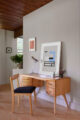
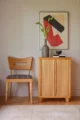
Heywood-Wakefield currently offers 56 pieces across their Living Room, Dining Room, Bedroom, Cabinet and Office collections. Most of these are archival designs, first introduced in the late 30’s through late 50’s, but some are recent introductions, either completely new designs by Tom or adaptations of vintage designs that have a more contemporary appeal. “I find that the design language of Heywood-Wakefield – the smoothed edges and the delicate curves paired with stark angles – aligns well with my tendency as a designer towards clean lines and simple forms,” says Belletete.


With the exception of a small collection in Black Walnut, everything is still built out of Northern Yellow Birch, which they buy from sustainably-managed forests in New England. The wood is particularly good for steam-bending, a technique Heywood-Wakefield uses throughout its designs to achieve their smooth curves without compromising the strength of long uninterrupted stretches of wood grain.

While vintage Heywood-Wakefield pieces are renowned for their sturdy construction, Tom has found ways to make them more robust. He combines an expertise in traditional joinery (developed over decades of working with his father and uncle) with the curiosity and skillset of an engineer (in a past career, he built infrared detection systems for the aerospace industry). “A lot of the old pieces were beautifully built, but we’ve improved upon the construction in two important ways. First, the finish we now use is much stronger than the old finish, which was notoriously susceptible to water and light damage. Second, the assembly systems are much stronger. One example is that the old pieces were often assembled by drilling directly into the wood, and over time, those holes would strip and the piece would wobble. Whenever possible, our new pieces fit together using threaded inserts and metal plates. They can be taken apart and put together repeatedly without becoming loose. Folks move and we want them to be able to move this furniture with them throughout their lives.”
Why Heywood-Wakefield Is Having a Moment Right Now
While the new iteration of the company has existed since 1992, it has experienced a surge in growth in the past few years. “For a long time, we sold mostly to collectors and folks who knew about us because they inherited their family’s pieces, but lately we’ve been reaching a new audience of people who appreciate our design heritage and the fact that we’re still building in America.” The company rephotographed its collection, launched an eCommerce website and, this February, went to the Palm Springs Modernism Show, their first trade show in 30 years.
“The American furniture industry has changed so much since Heywood-Wakefield’s mid-century peak,” says Tom. “The lower end of the furniture market we have today, imported products from Wayfair or Ikea, didn’t exist back then. Demand has changed as well; people are more likely to buy on price-point and replace their furniture frequently. That makes Heywood-Wakefield, which is still made in the US to really high standards, a pretty niche product. But for the folks who appreciate the classic MCM designs and the heirloom-quality construction, we resonate deeply, and we’re so excited that a new generation of people is discovering Heywood-Wakefield.”
Frequently Asked Questions About Heywood-Wakefield
Is today’s Heywood-Wakefield the same company as the original?
The current company holds the legitimate rights to the Heywood-Wakefield name and traces its lineage directly to the 1992 revival. It is not a licensed knockoff — it is the brand’s genuine continuation, operated by craftspeople deeply committed to the original standards of quality and design.
Where is Heywood-Wakefield furniture made today?
All furniture is built to order in Winchendon, Massachusetts, by a small team led by third-generation woodworker Tom Belletete. The company uses Northern Yellow Birch sustainably harvested from forests in Maine and the Northeast.
How does the price compare to vintage pieces?
New production Heywood-Wakefield furniture is built-to-order and priced accordingly — but given that original pieces in excellent condition have become genuinely scarce and expensive, new production pieces are often competitively priced with, or even less expensive than, comparable vintage originals.
Can I order custom pieces?
Yes. Heywood-Wakefield builds every piece to order and the company offers custom dimensions on many of its pieces, as well as 100+ fabric options for upholstered pieces, Customers Own Material and three finish colors. A trade program is also available for designers.
What wood does Heywood-Wakefield use?
The company uses solid Northern Yellow Birch, the same species that defined the original furniture’s look and durability. All wood is sustainably harvested from forests in Maine and the broader Northeast.
Does Heywood-Wakefield ship nationally?
Yes — the company offers free shipping throughout the continental United States on all orders.
The Bottom Line: Why This Revival Matters
In a market flooded with furniture built to be replaced, Heywood-Wakefield stands for the opposite. As a brand that has been around for well over 100 years, Heywood-Wakefield has built a legacy with its handcrafted, Art Deco-inspired mid-century modern furniture — and today’s company is dedicated to preserving that legacy by creating new pieces that incorporate updated technology and contemporary tastes.
Whether you’re a longtime collector completing a set, a first-time buyer drawn to the clean warmth of mid-century modern design, or simply someone tired of furniture that won’t make it to the next move — Heywood-Wakefield deserves your attention. Again.
Don’t forget to follow us on Instagram, Facebook, Pinterest and YouTube for more Atomic Ranch articles, house tours, and ideas!