

Gregory Ain is not the most well-known Mid Century Modern architect. But perhaps he would be better known beyond Los Angeles had history gone a bit differently. Ain dedicated his career to creating beautiful, comfortable, affordable modern homes for middle and working class Americans. Alas, his efforts to make housing fair and affordable would end up placing his career in the crosshairs of the Red Scare.
Gregory Ain: Early Life and Work Experience
Gregory Ain was born on March 28th, 1908 in Pittsburgh. He was raised in Los Angeles, however, where he had a chance to see the famous Schindler House by Rudolph M. Schindler. The house so inspired him that he decided to pursue a career in architecture. He briefly attended the University of Southern California School of Architecture. The program focused mainly on Beaux-Arts, which frustrated him. So, he dropped out.
Ain managed to find work with Richard Neutra in the early 1930s, after which he started up his own practice. He also worked with Charles and Ray Eames as Chief Engineer for their leg splints and plywood chairs in WWII.
Affordable Housing for All

Many architects focused on working with elite clients. But Gregory Ain’s primary interest was in making beautiful, high-quality housing affordable to everyday Americans. He was one of the architects during the 1930s and 1940s who pioneered open floor plans. Together with Joseph Johnson and Alfred Day, he helped create housing tracts in the Los Angeles area. He shared an office with architect James Garott, whom he worked with closely. He also did a lot of work with landscape architect Garrett Eckbo.

Perhaps the most famous project by Ain was the Avenel Cooperative Housing Project in Silver Lake, Los Angeles. Ten World War II veterans and their families who were in need of an affordable place to live came up with the idea of commissioning an affordable housing complex together. The contribution of each family in 1947 dollars was $11,000. That is equivalent to about $166,203 in 2026 dollars. The FHA provided funding for the project.
Reading this today, maybe you are fortunate enough to be doing so in a home of your own. If you are not though, you probably are aware how hard it is to find housing in good condition for that price in 2026.

“The Most Dangerous Architect in America”
Not everybody shared Gregory Ain’s idealism. His involvement in cooperative housing projects as well as his associations brought him under scrutiny during the Red Scare. This applied to some of his clients as well. In fact the House Un-American Activities Committee ended up questioning or blacklisting at least four of the people who commissioned him for the Avenel project.
Ain was investigated by the FBI, and J. Edgar Hoover called him “the most dangerous architect in America.”
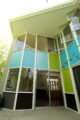
To give you another example of Ain’s “dangerous” projects, consider one that never even came to fruition, the Community Homes project in Reseda. It would have featured 16 blocks of homes, along with amenities like a school, shopping center and parks. The project was considered to be suspiciously communal in its nature. Moreover, the FHA took offense that people of all ethnicities would have been allowed to live in the same community.
Indeed, the FHA had a policy of redlining its mortgage approvals between 1934 and 1968. If you are not familiar with redlining, it is when mortgage approval depends on the ethnic composition of a neighborhood, rather than just the qualifications of an individual borrower.
Alexis C. Madrigal explains, “Otherwise celebrated for making homeownership accessible to white people by guaranteeing their loans, the FHA explicitly refused to back loans to black people or even other people who lived near black people.”

One would like to think that the consequences of redlining are behind us, but they are not. Research shows that people who live in areas that were redlined decades ago are at higher risk for diabetes, heart disease, hypertension, gunshot injuries, preterm birth, and early mortality.
Gregory Ain’s career didn’t end due to the Red Scare. He would continue to receive commissions throughout the 1950s and 1960s. But it did take a toll, and it is reasonable to assume he may have been more prolific in those years if not for the FBI’s scrutiny.
Moreover, the Red Scare became part of the structural violence that made it challenging for poor people and minorities to access affordable housing.
Think how different the world might be today had projects like Gregory Ain’s housing tracts and cooperatives been allowed, or even encouraged to flourish, rather than policies like redlining and the Red Scare.
But that is not the world we got. We got the one where homeownership remains out of reach for a large percentage of Americans, and where people continue to suffer physical and psychological harm from the policies of decades past. Moreover, discriminatory practices still exist in lending and in zoning laws.
If you enjoyed this post, you may also like William Krisel: Master of the Midcentury Tract Home and A. Quincy Jones Transforms the Modern Tract Home.
And of course, don’t forget to follow us on Instagram, Facebook, Pinterest and YouTube for more Atomic Ranch articles, house tours, and ideas!